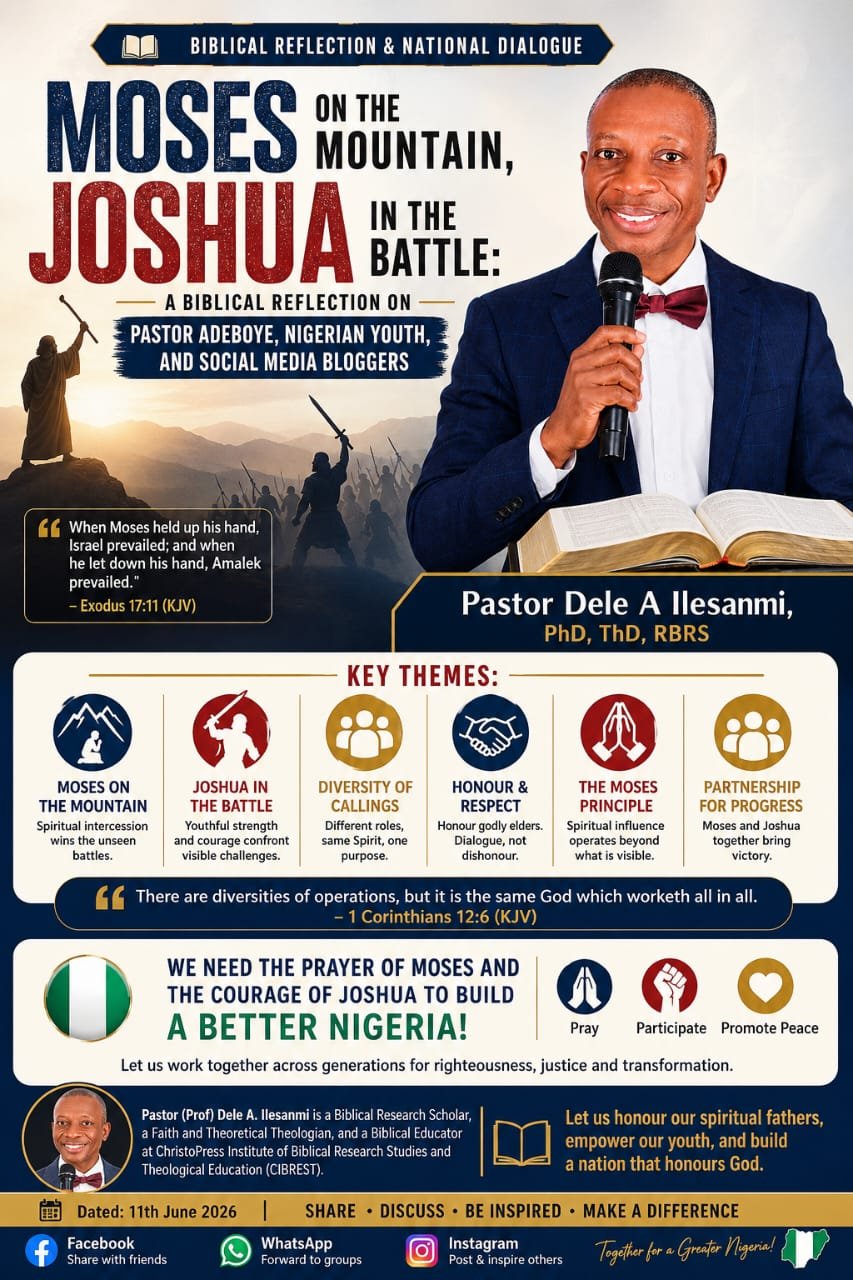
Moses on the Mountain, Joshua in the Battle: A Biblical Reflection on Pastor Adeboye, Nigerian Youth, and Social Media Bloggers

Pastor Dele A Ilesanmi, PhD, ThD, RBRS
Introduction
The rise of social media has transformed public discourse in Nigeria. Virtually every national issue now attracts immediate reactions from bloggers, influencers, commentators, and ordinary citizens. While this development has enhanced freedom of expression and civic engagement, it has also created an environment where individuals are frequently judged without a proper understanding of their calling, responsibilities, limitations, or divine assignments.
For instance, in recent weeks, social media platforms in Nigeria have been flooded with irrational criticisms directed at Pastor Enoch Adejare Adeboye, a revered General Overseer of the Redeemed Christian Church of God. Some critics have questioned why the elderly cleric did not personally participate in public protests or demonstrations concerning the nation’s socio-economic and security challenges, particularly following the recent kidnapping of some schoolchildren and their teachers in Ogbomoso, Oyo State. Others have compared his present posture with previous public engagements, while some have argued that spiritual leaders ought to be more visibly involved in political activism. These criticisms have generated intense debates across various online communities. To many critics, silence or non-participation is interpreted as indifference. However, a biblical examination of spiritual leadership reveals a different perspective.
The story of Moses and Joshua during Israel’s battle against Amalek provides a powerful framework for understanding the relationship between spiritual fathers, younger generations, and public engagement. It also offers important lessons for social media commentators who often evaluate spiritual leaders through political rather than biblical lenses.
The Danger of Misjudging God’s Servants
One of the recurring patterns in Scripture is the tendency of people to misunderstand those whom God has called. Jesus Himself experienced this reality. Although He taught with extraordinary wisdom and performed mighty works, many people rejected Him because they were overly familiar with Him: “Is not this the carpenter’s son?” (Matt 13:55 KJV). As a result, they failed to appreciate His divine mission. Jesus, therefore, declared: “A prophet is not without honour, save in his own country, and in his own house” (Matt 13:57 KJV). Consequently, Jesus could not do mighty works in His home country because of their unbelief (Matt 13:58 KJV). History repeatedly confirms that great leaders are often criticised by their contemporaries and celebrated only after their departure. The issue is not always the absence of leadership; sometimes it is the inability of observers to understand the nature of that leadership. Many a time we blame the wrong person for our failure to do the right thing.
Moses on the Mountain
The biblical account in Exodus 17:8–13 presents one of the clearest examples of differentiated assignments within the Kingdom of God. When Amalek attacked Israel, Moses did not march into the battlefield with a sword. Instead, he ascended a mountain to pray carrying the rod of God. Meanwhile, Joshua led the younger men like him into combat. At first glance, an uninformed observer might have accused Moses, their leader, of avoiding the battle, just as we experience today. A spiritually blind modern social media blogger or commentator might have written:
“Why is Moses sitting on a hill while young people are risking their lives below?” “If Moses truly cared about Israel, he should be fighting on the front line.” “The old man is detached from the struggles of ordinary people.” “He is our leader, but he kept silent, sitting on the mountain to watch the scene.” “Does Israel need prayer now? Or they go out against the enemies?” “What we need now is not prayer, but war.”
Yet Scripture reveals a completely different reality. Moses was not absent from the battle. He was fighting from another dimension. The Bible says, “And it came to pass, when Moses held up his hand, that Israel prevailed” (Exod 17:11 KJV). Joshua’s sword was effective because Moses’ intercession was effective. The battle in the valley was connected to the prayer on the mountain. Where there is no nexus between the battle in the valley and the prayer on the mountain, defeat is inevitable.
Joshua in the Battle
Joshua represents youthful strength, courage, activism, and engagement. Scripture says, “The glory of young men is their strength” (Prov 20:29 KJV). God often uses young people to confront visible challenges. For example,
- Young David confronted Goliath (1 Samuel 17:45–50).
- Young Joshua led military campaigns (Joshua 1:1–9).
- Young Jeremiah was commissioned as a prophet to nations (Jeremiah 1:6–8).
- Young Timothy was encouraged by Paul not to allow anyone to despise his youth (1 Timothy 4:12).
Throughout biblical history, God entrusted many demanding assignments to younger generations because they possessed the energy and physical capacity required for such tasks, such as lawful public protests. There is therefore nothing wrong when Nigerian youths, including young Christians, seek positive change, advocate for justice, challenge corruption, rise against insecurity in their land, or demand accountability through lawful and peaceful means. Indeed, responsible civic engagement can be a legitimate expression of good citizenship and stewardship. In other words, citizens have the legal right to challenge, ask, or petition their leaders on how their society is being governed in a lawful and peaceful manner.
The Error of Social Media Judgement
The problem arises when some bloggers and commentators assume that everyone must engage in societal issues exactly as they do. Social media often rewards speed rather than wisdom. It rewards outrage rather than reflection. It rewards criticism rather than understanding. Consequently, many commentators evaluate spiritual leaders using standards that Scripture itself does not employ. The Apostle Paul teaches, “For as we have many members in one body, and all members have not the same office” (Rom 12:4 KJV). Equally, “There are diversities of gifts, but the same Spirit” (1 Cor 12:4 KJV). Not every servant of God is called to stand before cameras. Not every minister is called to organise protests. Not every leader is called to engage in political activism. Some are called to preach. Some are called to lead. Some are called to counsel. Some are called to advocate. Some are called to research, teach, and write. Some are called to govern. Some are called to intercede. The Kingdom functions effectively because of these differences.
Pastor Adeboye and the Moses Principle
Pastor E.A. Adeboye’s ministry for decades has been characterised by prayer, evangelism, discipleship, mentorship, church planting, and spiritual leadership. His influence has extended across nations, generations, and denominations. At over eighty years of age, his primary contribution to society naturally differs from that of a twenty-five-year-old activist or commercial social media bloggers and commentators. This is neither weakness nor irrelevance. It is the wisdom of divine assignment. Just as Moses’ effectiveness was not measured by the number of enemies he physically confronted, Pastor Adeboye’s effectiveness should not be measured solely by his participation in public demonstrations or protests.
The Moses Principle teaches that spiritual influence often operates beyond what is visible to the public. The greatest battles are not always fought before cameras. Some are fought in prayer rooms. Some are fought through mentorship and discipleship. Some are fought through moral influence. Some are fought through spiritual intercession.
Honouring Spiritual Fathers
Scripture repeatedly commands believers to honour godly elders. Solomon wrote: “The hoary head is a crown of glory, if it be found in the way of righteousness” (Prov 16:31 KJV). Peter instructed, “Likewise, ye younger, submit yourselves unto the elder” (1 Pet 5:5 KJV). This does not prohibit disagreement. Neither does it require unquestioning loyalty. However, it does require respect, civility, and humility. Sadly, social media culture often encourages mockery, insults, and contempt, particularly towards spiritual and older leaders. Such attitudes do not reflect biblical or African values. The Bible encourages dialogue, correction, and accountability, but never dishonour. If any young person does not respect elders, particularly their spiritual fathers, it is a reflection of home – such a fellow lacks home training.
The Need for Partnership Between Moses and Joshua
The lesson of Exodus 17 is not that Joshua should stop fighting. Neither is it that Moses should leave the mountain. The lesson is partnership. Israel won because both generations worked together. Joshua needed Moses. Moses needed Joshua. The young warriors needed spiritual covering. The spiritual leader needed committed followers. The same principle applies today. We need spiritual leaders like Daddy Adeboye. Spiritual leaders like Daddy Adeboye need courageous young Nigerians to be on the battlefield or to engage in protests. Indeed, Nigeria needs courageous young people willing to contribute positively to national development. Nigeria also needs spiritual fathers who provide wisdom, prayer, moral guidance, and godly counsel. The future belongs not to one generation acting alone but to generations working together.
Conclusion
Based on Moses-Joshua Methodology, the criticism of Pastor E.A. Adeboye by some social media bloggers and young Nigerians reveals a deeper misunderstanding of biblical leadership. Exodus 17 teaches that victory comes when Moses remains faithful on the mountain and Joshua remains faithful in the battle. Both assignments are important. Both assignments are necessary. Both assignments are ordained by God. Instead of demanding that every leader perform the same role, believers should learn to appreciate the diversity of callings within God’s Kingdom. As the Apostle Paul reminds us, “There are diversities of operations, but it is the same God which worketh all in all” (1 Cor 12:6 KJV). May God grant Nigerian youths the courage of Joshua, social media commentators the wisdom of discernment, and spiritual fathers the perseverance of Moses, so that together they may labour for the peace, righteousness, and transformation of our dear country Nigeria.
- Pastor (Prof) Dele A. Ilesanmi is a Biblical Research Scholar, a Faith and Theoretical Theologian, and a Biblical Educator at the ChristoPress Institute of Biblical Research Studies and Theological Education (CIBREST).